
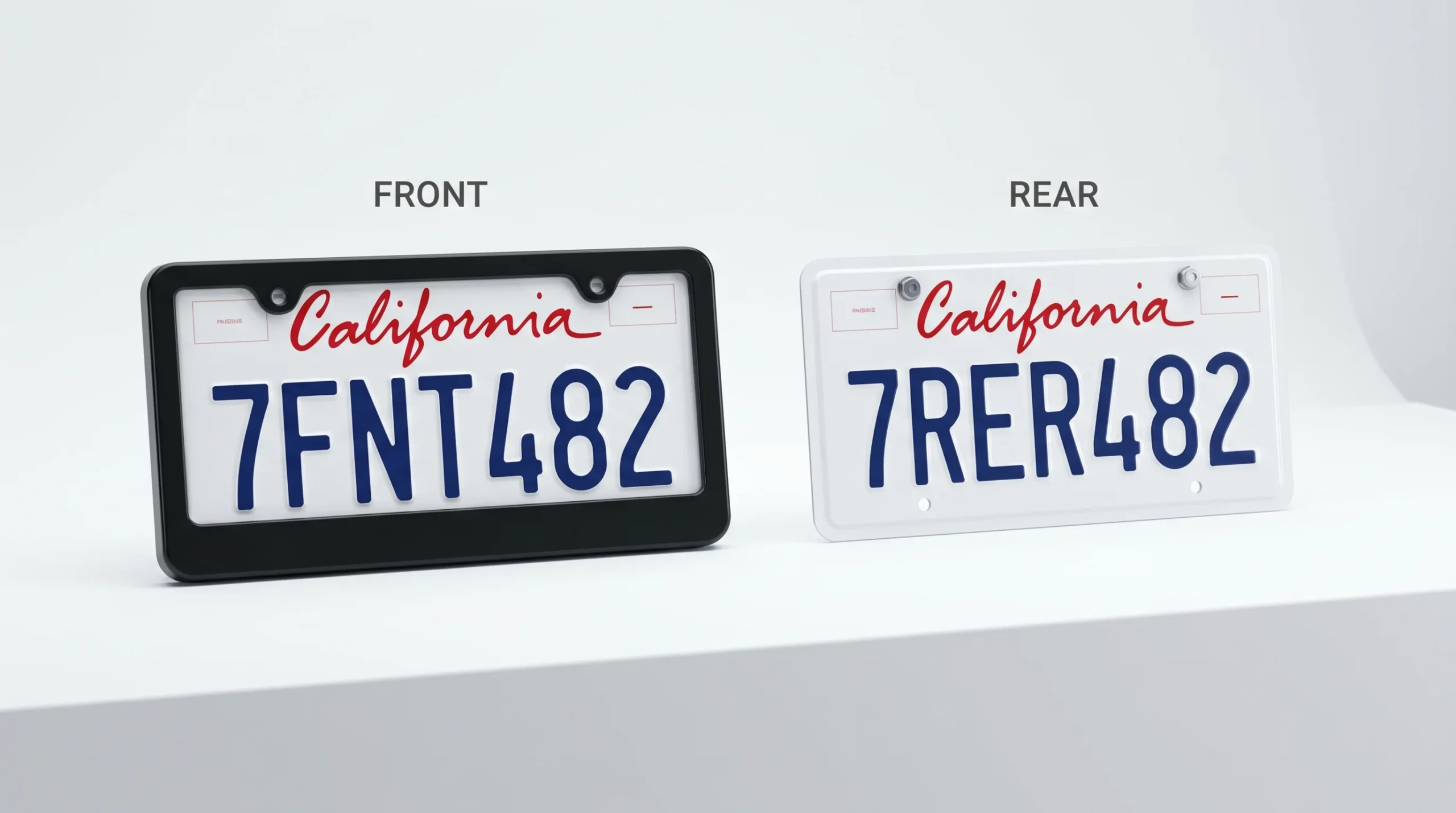
Quick Answer: 29 U.S. jurisdictions (28 states plus Washington D.C.) require a front license plate. The remaining 22 states require only a rear plate. Driving without a required front plate can result in fines ranging from $25 to $200 depending on the state. Utah dropped its front plate requirement on January 1, 2025 — the most recent state to do so.
| Require Front Plate (29) | Rear Plate Only (22) |
|---|---|
| CA, TX, NY, IL, WA, VA, MA, CO, CT, HI, IA, ID, ME, MD, MN, MO, MT, NE, NV, NH, NJ, ND, OR, RI, SD, VT, WI, WY + D.C. | AL, AK, AR, AZ, DE, FL, GA, IN, KS, KY, LA, MI, MS, NM, NC, OH, OK, PA, SC, TN, UT, WV |
One plate or two? It sounds like a simple question, but the answer depends entirely on which state you’re registered in — and getting it wrong can cost you a ticket, even if your car looks perfectly clean without a front plate. This guide covers every state’s rules, recent changes, fine amounts, and what to do if your car didn’t come with a front bracket.
Table of Contents
Which States Require a Front License Plate in 2026?
As of 2026, 28 states plus Washington D.C. require both a front and rear license plate on passenger vehicles. Here’s the full list:
| State | Front Plate Required? | Notes |
|---|---|---|
| California | Yes | Strictly enforced; fine ~$196 |
| Texas | Yes | Fine $1–$500 depending on jurisdiction |
| New York | Yes | Required on all registered vehicles |
| Illinois | Yes | Required; fix-it ticket available |
| Washington | Yes | Required |
| Virginia | Yes | Required |
| Massachusetts | Yes | Required |
| Colorado | Yes | Required |
| Connecticut | Yes | Required |
| Hawaii | Yes | Required |
| Iowa | Yes | Required |
| Idaho | Yes | Exempt if no bracket on vehicle |
| Maine | Yes | Required |
| Maryland | Yes | Required |
| Minnesota | Yes | Required |
| Missouri | Yes | Required |
| Montana | Yes | Required |
| Nebraska | Yes | Required |
| Nevada | Yes | Required |
| New Hampshire | Yes | Required |
| New Jersey | Yes | Required |
| North Dakota | Yes | Required |
| Oregon | Yes | Required |
| Rhode Island | Yes | Required |
| South Dakota | Yes | Required |
| Vermont | Yes | Required |
| Wisconsin | Yes | Required |
| Wyoming | Yes | Required |
| Washington D.C. | Yes | Required |
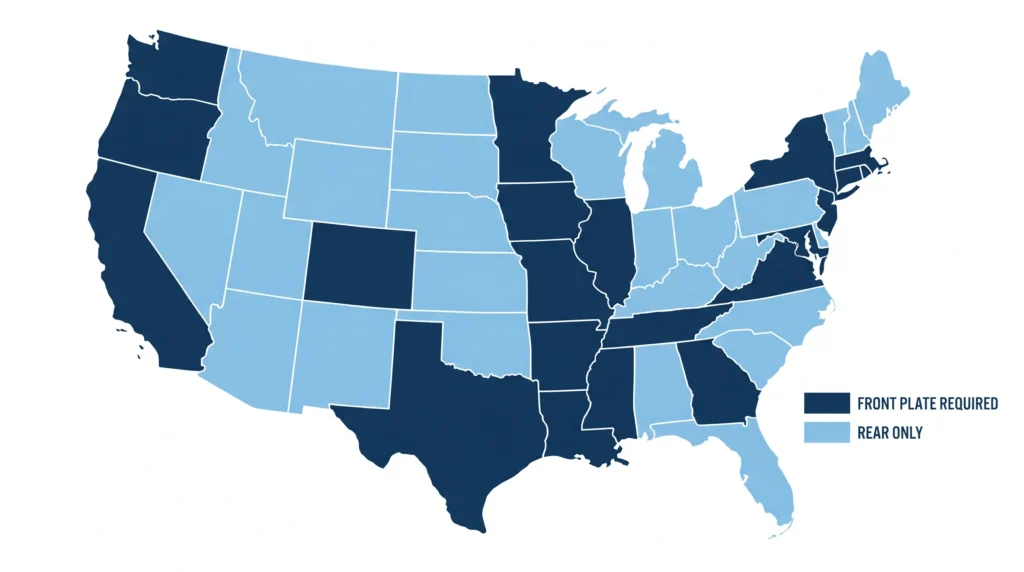
Which States Do NOT Require a Front License Plate?
These 22 states require only a rear plate. If your car is registered here, you’re under no legal obligation to mount a front plate — and many drivers choose not to in order to preserve the look of their bumper.
| State | Front Plate Required? | Notes |
|---|---|---|
| Alabama | No | Rear only |
| Alaska | No | Dropped requirement in 2022 |
| Arizona | No | Rear only |
| Arkansas | No | Rear only |
| Delaware | No | Rear only |
| Florida | No | Rear only |
| Georgia | No | Rear only |
| Indiana | No | Rear only |
| Kansas | No | Rear only |
| Kentucky | No | Rear only |
| Louisiana | No | Rear only |
| Michigan | No | Rear only |
| Mississippi | No | Rear only |
| New Mexico | No | Rear only |
| North Carolina | No | Rear only |
| Ohio | No | Dropped requirement in 2020 |
| Oklahoma | No | Rear only |
| Pennsylvania | No | Rear only |
| South Carolina | No | Rear only |
| Tennessee | No | Rear only |
| Utah | No | Dropped requirement January 1, 2025 |
| West Virginia | No | Rear only |
What Is the Fine for Not Having a Front License Plate?
If you’re registered in a state that requires a front plate and you’re driving without one, you can be pulled over and ticketed. Fine amounts vary widely:
- California: ~$196 for a license plate display failure
- Texas: $1–$500 depending on the local jurisdiction
- Most other states: typically $25–$100
Many states offer a fix-it ticket (also called a correctable violation). If you mount the front plate and get the correction verified by law enforcement or the DMV, the ticket is dismissed with little or no fee. If you’re pulled over in a two-plate state, ask whether your state allows fix-it tickets before paying the fine outright.
One important note: even in states that don’t require a front plate, your car must still display a valid, unobstructed rear plate. Tinted plate covers, frames that block the registration sticker, or dirty plates that obscure the number can all result in a separate infraction.
Why Do Some States Require a Front License Plate and Others Don’t?
There’s no federal law mandating front plates — it’s entirely a state-by-state decision. States that require them cite several reasons:
- Law enforcement identification: Officers and traffic cameras can identify a vehicle from the front, not just the rear. This matters at intersections, toll roads, and red-light cameras.
- Hit-and-run investigations: Witnesses to accidents are far more likely to see the front of a fleeing vehicle than the rear.
- Toll collection: Many electronic toll systems use front-facing cameras. Without a front plate, toll evasion becomes easier.
States that dropped the requirement point to different priorities:
- Cost: Manufacturing, issuing, and replacing two plates per vehicle costs states money.
- Aesthetics: Many car owners and manufacturers prefer the clean look of a front bumper without a plate — especially on performance and luxury vehicles.
- ADAS compatibility: Some modern vehicles have front radar and camera systems that can be affected by a bracket-mounted plate. GM has documented cases where a bent front license plate triggered false collision warnings.
- Environmental impact: Fewer metal plates means less aluminum production and waste.
What If Your Car Didn’t Come With a Front License Plate Bracket?
This is a real frustration for drivers in two-plate states who buy cars designed without a front bracket — particularly European imports, sports cars, and some luxury vehicles. Many manufacturers leave front plate mounting as an afterthought, or don’t include a bracket at all.
Your options:
1. Dealer-installed bracket (drill method)
Most dealerships will mount a front plate by drilling directly into the bumper. This is the most common approach but permanently damages the bumper. It significantly reduces resale value on premium vehicles and cannot be undone without body work.
2. No-drill license plate bracket
No-drill mounts attach using the tow hook receptacle, existing bumper gaps, or adhesive mounting points — no holes required. They’re vehicle-specific and range from $30–$150. This is the best option for anyone who cares about their bumper’s appearance or plans to sell the car.
3. Tow hook mount
Many European vehicles have a removable tow hook cover on the front bumper. Specialty brackets thread into that same mount point, giving a clean, centered plate position with no drilling required.
4. Temporary display
Some drivers place the plate inside the windshield behind the glass. This is not legal in most two-plate states — the plate must be mounted on the exterior of the vehicle and clearly visible. Don’t rely on this approach to avoid a ticket.
Can a Front License Plate Interfere With Your Car’s Safety Systems?
Yes — and this is a legitimate concern on modern vehicles. Most cars built after 2018 use front-facing cameras and radar sensors for safety features like automatic emergency braking, adaptive cruise control, and lane-keep assist. These systems are part of what the industry calls Advanced Driver Assistance Systems (ADAS).
A poorly positioned or bent front license plate can block or reflect radar signals, causing false alerts. GM has officially documented cases where a bent front plate caused the Forward Collision Alert system to trigger warnings with no obstacle present. Removing the plate resolved the issue.
If you drive a newer vehicle and are required to mount a front plate, use a vehicle-specific no-drill bracket designed to position the plate below or away from sensor locations. Avoid universal brackets that position the plate directly over radar emitters or camera lenses.
Which States Have Recently Changed Their Front Plate Laws?
The long-term trend is moving toward rear-only requirements. Three states have dropped the front plate mandate in recent years:
- Ohio (2020): Eliminated the front plate requirement, saving the state an estimated $1.3 million per year in plate production costs.
- Alaska (2022): Moved to rear-only plates.
- Utah (January 1, 2025): The most recent state to drop the requirement, effective at the start of 2025.
Several other states have had active legislative proposals to eliminate front plates in recent years, including Virginia, Minnesota, and Illinois. None have passed as of 2026, but the trend is worth watching if you live in a two-plate state.
Do You Need a Front License Plate?
It depends entirely on where your vehicle is registered. Here’s how to know for sure:
- Check the table above for your state
- If your state is on the “required” list, mount your plate — the fine and the hassle of a traffic stop aren’t worth skipping it
- If you’re in a two-plate state with a car that lacks a front bracket, invest in a no-drill mount to protect your bumper
- If you recently moved from a one-plate state to a two-plate state, update your registration and mount your front plate before driving
License plates are one of the most overlooked parts of car ownership — until you get pulled over. For more on the history and design behind the plates on your car, explore our license plate guides, including the story behind California license plates and our look at unique license plate designs from around the world.