
Quick Answer: Most modern cars using full synthetic oil need an oil change every 7,500–10,000 miles. Cars running conventional oil should change it every 5,000–7,500 miles. The old “every 3,000 miles” rule is outdated for most vehicles built in the last two decades. Always check your owner’s manual for your specific vehicle’s recommended interval.
| Driver Type | Recommended Interval |
|---|---|
| Modern car, synthetic oil | 7,500–10,000 miles |
| Turbocharged engine | 5,000–7,500 miles |
| Older car / conventional oil | 5,000–7,500 miles |
| Severe driving conditions | Reduce by 1,000–2,000 miles |
| Low-mileage driver | At least once per year |
If you’ve been pulling into the quick-lube shop every 3,000 miles, you’re probably changing your oil more often than your car actually needs. The 3,000-mile rule made sense decades ago when engines and oil technology were far less advanced. For most vehicles built after 2000, it’s no longer the standard.
This guide breaks down exactly when to change your oil based on mileage, oil type, engine type, and driving conditions. Whether you drive a 2010 Honda Civic or a brand-new turbocharged SUV, you’ll know exactly what your car needs — and what it doesn’t.
Table of Contents
How Many Miles Between Oil Changes Does Your Car Actually Need?
The right oil change interval depends on two things: what type of oil your car uses and how hard your engine works. Here’s the breakdown:
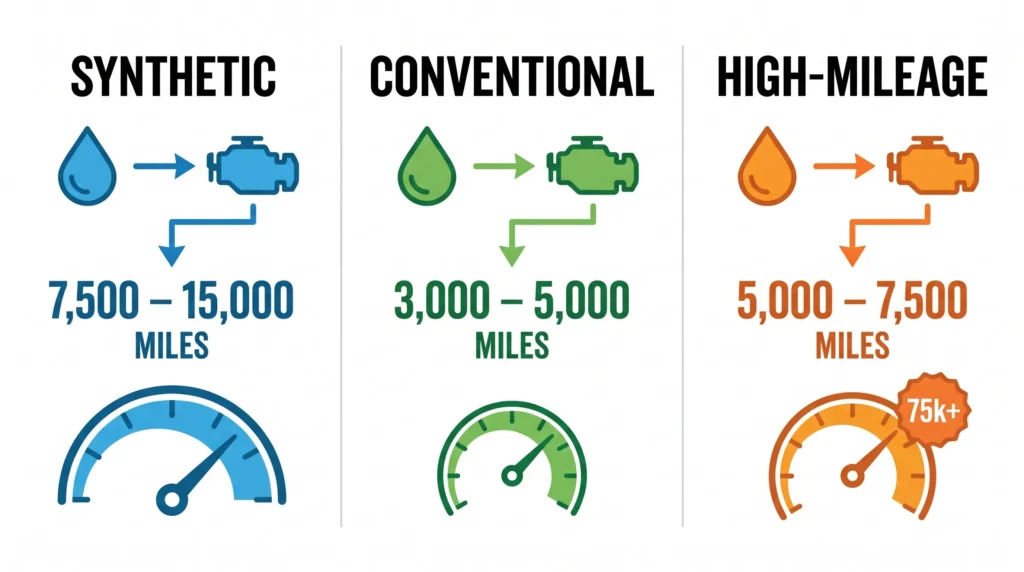
| Oil Type | Recommended Interval | Best For |
|---|---|---|
| Conventional oil | 5,000–7,500 miles | Older vehicles, low-mileage drivers, mild climates |
| Synthetic blend | 6,000–7,500 miles | Mid-range vehicles, moderate driving conditions |
| Full synthetic | 7,500–10,000 miles | Most modern vehicles, highway drivers, performance cars |
| Full synthetic (extended) | 10,000–15,000 miles | BMW, some Volkswagen/Audi models with specific oil specs |
| High-mileage oil | 5,000–7,500 miles | Vehicles with 75,000+ miles on the odometer |
The single most reliable source for your specific car? Your owner’s manual. Manufacturers spend millions engineering their engines and specifying exactly what oil and what interval keeps them running longest. Ignoring that recommendation can void your warranty.
Is the 3,000-Mile Oil Change Rule Still Valid in 2026?
No — and it hasn’t been for a long time. The 3,000-mile rule dates back to the 1960s and 70s, when engines had tighter tolerances, oil degraded faster, and filter technology was far more primitive. Modern engines and synthetic oils have changed the equation completely.
According to CalRecycle, most vehicles today can go 5,000 miles or more between oil changes, and many modern cars using full synthetic oil are rated for 10,000 miles or longer. The California agency actively campaigns against the 3,000-mile myth because over-changing oil creates unnecessary used oil waste.
AAA echoes this: their research found that many newer vehicles can safely go 5,000 miles or more between changes, with full-synthetic vehicles often stretching to 7,500–10,000 miles without any increased engine wear.
Over-changing oil wastes money and creates unnecessary used-oil waste, which is why CalRecycle actively discourages the outdated 3,000-mile rule. The recommendation still gets repeated because it is familiar, simple, and profitable for service shops — but it is not what modern engines actually require.
Bottom line: If your car is a 2010 or newer and uses full synthetic oil, you almost certainly don’t need an oil change every 3,000 miles.
What Happens If You Go Too Long Between Oil Changes?
Stretching past the recommended mileage interval isn’t harmless. Oil breaks down over time and loses its ability to protect your engine. Here’s what actually happens when oil gets too old:
- Viscosity breakdown: Oil gets thicker and less fluid, creating friction between moving metal parts.
- Sludge buildup: Oxidized oil forms thick deposits that clog oil passages and restrict flow to critical components.
- Increased engine wear: Metal-on-metal contact accelerates wear on bearings, camshafts, and piston rings.
- Overheating risk: Oil also helps cool the engine. Degraded oil is less effective at dissipating heat.
- Reduced fuel economy: A harder-working engine uses more fuel.
The damage isn’t always immediate. Sludge buildup in particular is a slow, cumulative problem that can cost $3,000–$8,000 to repair once it progresses to full engine damage. Staying close to your manufacturer’s recommended interval is cheap insurance.
For more on how neglected maintenance leads to bigger problems, see our guide on how regular maintenance keeps you safe on the road.
Does Driving Style Affect Oil Change Intervals?
Yes — significantly. Automakers define two driving categories: normal and severe. Most people assume they fall into the normal category. Many actually don’t.
What Counts as Severe Driving?
- Frequent short trips (under 5 miles) — the engine never fully warms up, causing moisture and fuel contamination in the oil
- Stop-and-go city traffic — constant acceleration and braking puts more stress on the engine than highway cruising
- Extreme temperatures — both very hot and very cold weather accelerate oil degradation
- Towing or hauling — the engine works harder and generates more heat
- Dusty or dirty environments — more contaminants entering the engine through the air intake
- Lots of idling — delivery drivers, rideshare drivers, or anyone who idles frequently
If your driving matches two or more of the above, drop your interval by about 1,000–2,000 miles from the standard recommendation. A full-synthetic car normally changed at 10,000 miles might be better served at 7,500–8,000 miles under severe conditions.
How Do Turbocharged Engines Change the Oil Change Equation?
Turbocharged engines — now standard on most new vehicles from Ford, Honda, GM, and nearly every European brand — require more frequent oil changes than naturally aspirated engines. Here’s why:
A turbocharger spins at up to 200,000 RPM and generates enormous heat. Oil is the primary cooling and lubricating agent for the turbo bearings. When you shut off a hot turbocharged engine, the turbo keeps spinning for a moment without active oil flow — this is called “heat soak,” and it rapidly degrades oil quality in that area of the engine.
Recommendation for turbocharged engines: Stick to the lower end of your manufacturer’s interval — typically 5,000–7,500 miles — even if the manual technically allows longer. The extra oil change costs far less than turbocharger replacement, which runs $1,500–$4,000+ on most vehicles.
What’s the Right Oil Change Interval If You Don’t Drive Much?
Mileage isn’t the only clock running on your oil. Time matters too. Even if you only drive 3,000 miles a year, you should still change your oil at least once every 12 months.
Here’s why: oil degrades through oxidation, even when the car is sitting. Moisture accumulates in the crankcase. Acids build up. A car that sits for extended periods can have oil that looks clean on the dipstick but is chemically spent.
The safest rule for low-mileage drivers: change your oil every 6 months or per the mileage interval — whichever comes first.
How Does an Oil Life Monitoring System Work?
Most vehicles built after 2010 include an Oil Life Monitoring (OLM) system — a dashboard indicator that tells you when your oil actually needs changing, rather than defaulting to a fixed mileage interval.
OLM systems use algorithms that track:
- Engine revolutions — how hard the engine has been working
- Operating temperatures — how hot the oil has gotten
- Idle time — time spent not moving but engine running
- Cold starts — particularly hard on oil quality
The system calculates an oil life percentage. When it drops to 15–20%, the car alerts you to schedule a change. When it hits 0%, the alert becomes more urgent.
Important: An OLM system is not a substitute for checking your oil manually. The system measures oil condition algorithmically — it can’t physically detect a leak or unusually fast oil breakdown. Check your dipstick every 1,000–2,000 miles regardless of what the monitor says.
How Much Does an Oil Change Cost by Oil Type in 2026?
Oil change costs have risen in recent years due to higher labor rates, rising synthetic oil prices, and stricter disposal regulations. Here’s what to expect in 2026:
| Oil Type | Average Cost (Shop) | Interval | Annual Cost (est.)* |
|---|---|---|---|
| Conventional | $35–$75 | 5,000–7,500 mi | $70–$225 |
| Synthetic blend | $45–$90 | 6,000–7,500 mi | $90–$225 |
| Full synthetic | $65–$130 | 7,500–10,000 mi | $65–$260 |
| High-mileage synthetic | $70–$140 | 5,000–7,500 mi | $140–$420 |
*Annual cost estimate assumes 15,000 miles driven per year at mid-range pricing.
One important takeaway: full synthetic costs more per visit but less per year for most drivers, because you’re going to the shop half as often. The premium price per quart doesn’t mean a higher annual maintenance bill — it usually means the opposite.
What Are the Signs You Need an Oil Change Now (Regardless of Mileage)?
Sometimes your car tells you it needs an oil change before you hit the recommended mileage. Don’t ignore these signals:
- Dark, gritty oil on the dipstick — fresh oil is amber/golden; black oil with visible particles means it’s overdue
- Engine knocking or ticking — a sign oil isn’t lubricating properly
- Burning oil smell inside the cabin — could indicate a leak dripping on hot engine components
- Oil warning light — this means oil pressure is critically low; pull over safely and check immediately
- Exhaust smoke — blue/gray smoke often indicates oil burning in the combustion chamber
- Reduced fuel economy — degraded oil creates more engine friction, which uses more fuel
If you notice any of these signs, don’t wait for the mileage reminder. Change the oil immediately and have the car inspected if symptoms persist after the change.
Keeping your brakes in good shape matters just as much as your oil — read our breakdown of 10 signs your car brakes are screaming for attention.
Which Oil Is Right for Your Car?
The label on the oil bottle shows a code like 5W-30 or 0W-20. This is the oil viscosity rating — and using the wrong one is a common, avoidable mistake.
- The “W” stands for Winter — the first number describes how the oil flows in cold temperatures. Lower numbers (0W, 5W) flow better in the cold, which matters for cold starts.
- The second number describes viscosity at operating temperature. Higher numbers (30, 40, 50) are thicker and better for high-heat applications.
Always use the viscosity grade your owner’s manual specifies. Using a thicker oil in an engine designed for thinner oil can starve it of lubrication on cold starts. Using thinner oil in an engine built for thicker oil can reduce film strength at high temperatures.
Common specs by vehicle type:
- Most modern gas cars: 0W-20 or 5W-30 full synthetic
- Older vehicles and trucks: 5W-30 or 10W-30 conventional or synthetic blend
- High-performance and European engines: Often require specific grades like 5W-40 or 0W-40
- High-mileage vehicles (75,000+ miles): High-mileage formula in the same viscosity grade
Bottom Line: What’s the Right Oil Change Mileage for Your Car?
The short answer: check your owner’s manual, trust your oil life monitor, and stop changing your oil every 3,000 miles unless your manual specifically calls for it. Here’s a quick reference:
- Modern car, full synthetic, normal driving: Every 7,500–10,000 miles
- Turbocharged engine: Every 5,000–7,500 miles
- Older car or conventional oil: Every 5,000–7,500 miles
- Severe driving conditions: Drop 1,000–2,000 miles from your standard interval
- Low-mileage driver: At minimum, once per year
- High-mileage vehicle (75k+ miles): Use high-mileage oil, every 5,000–7,500 miles
Oil changes are one of the cheapest forms of engine insurance available. Get them done on the right schedule — not too often, and definitely not too late — and your engine can easily go 200,000+ miles without major problems.
Want to stay on top of everything your car needs? Browse all our car maintenance guides for practical, no-fluff advice on keeping your vehicle running longer.